Skip to what matters to you:
I never imagined myself to be a triathlete.
I am an adventurer. A wanderer. The kind of guy who hitchhiked from Toronto to Vancouver just to see my country. The next year, I cycled more than 3,351 kilometers from Toronto to St. John’s—because why the hell not?
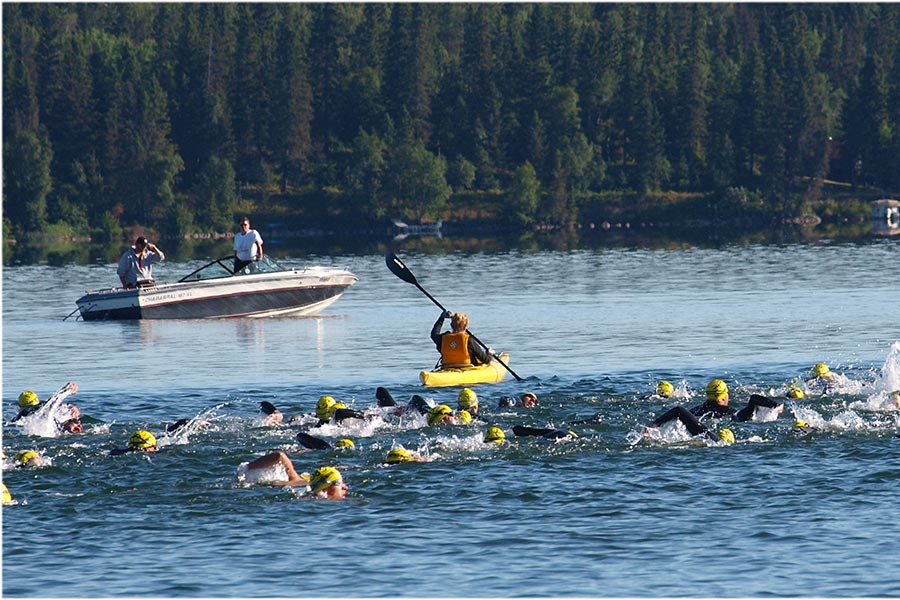
Yet there I was, standing on the shore of Clear Lake in Riding Mountain National Park in 2013, about to do something that terrified me more than either of those journeys: swim in open water with 109 other people.
Here’s why that scared the living shit out of me:
When I was twelve, my dad and his friend took me out to a sand dune beach somewhere near Grand Bend. We waded far from shore, me clutching a pool noodle, when they started joking about barracudas and fish that liked to eat little kids. I panicked, swam back as fast as I could, and didn’t go near the water for the rest of the day.
Guess what? That fear of water never left.
Thanks a bunch, dad!
It’s kind of crazy. I’d spent three years as a tree planter—trekking hundreds of kilometers through the bush, bending over thousands of times a day to shove seedlings into the ground. I’d encountered black bears on trails. Survived clouds of blackflies that would drive anyone insane. Worked in rain, heat, and cold that broke most people who tried it.
But swimming? In a lake? With seaweed tangling around my legs, pulling me under to God knows what would eat me alive?
Yeah, no thanks. Fu*k that!
Why Triathlons?
This is going to sound stupid, but I was heartbroken.
I’d moved to Winnipeg to be with who I thought, at the time, was the love of my life. When that fell apart, I felt aimless. I lost all purpose and I needed a proper cure for my depression (because drowning it in alcohol just wasn’t cutting it).
I needed something that matched my intensity. Something that would push me physically the way my adventures had. Something that would be completely mine.
Triathlons became that something.
So, I started with a sprint because I honestly had no idea what I was capable of.
Could I handle the Olympic distance? I don’t know. Maybe. But a sprint? 750-meter swim, 20k bike, 5k run? That seemed like the perfect distance to test myself without biting off more than I could chew.
As for training? I went to the pool a few times. Swam some laps. Counted them in my head because I wasn’t tech-savvy back then. No Garmin. No Strava. No apps.
I also figured my fitness from tree planting and cycling would carry me. The bike? No problem. The run? I could suffer through anything. The swim? Well, I’d just have to not drown and hope for the best.
That was the plan.
Riding Mountain Triathlon 2013
Event Information
- Event name: Riding Mountain Triathlon
- Location: Clear Lake, Riding Mountain National Park, Manitoba
- Race types: Sprint, Olympic
- Website/registration link: www.windburnraceteam.com/riding-mountain-triathlon
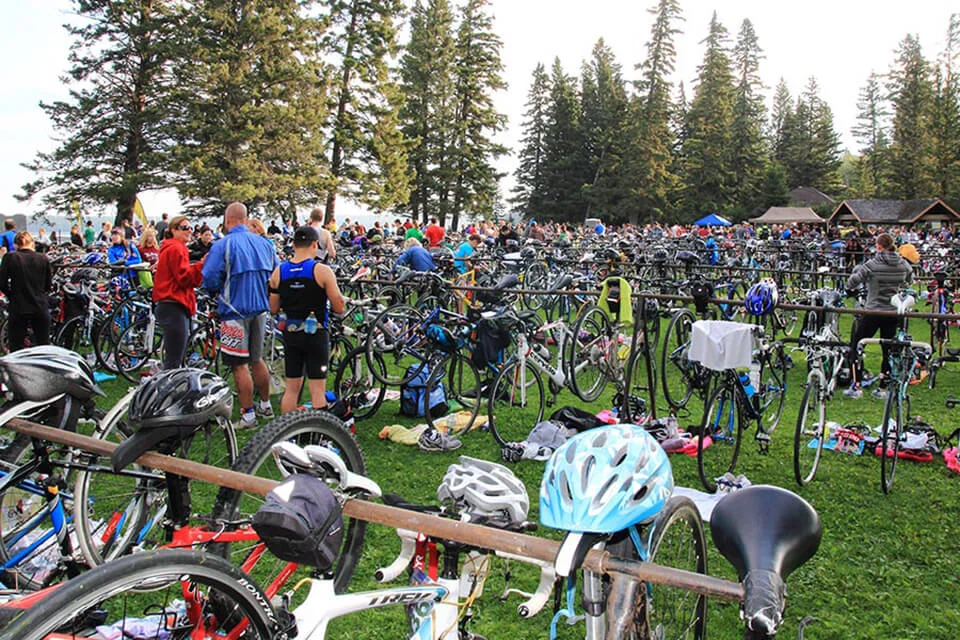
The weather was perfect. Sunny, warm, not a cloud in the sky. I carpooled with another competitor, and when we rolled into Riding Mountain National Park, the place was stunning. Clear Lake sparkled under the morning sun, surrounded by dense forest while the transition areas buzzed with nervous excitement.
Everyone looked so prepared. Expensive tri bikes gleaming in the sun. Aero helmets. Race kits that probably cost more than my entire setup. These people knew what they were doing.
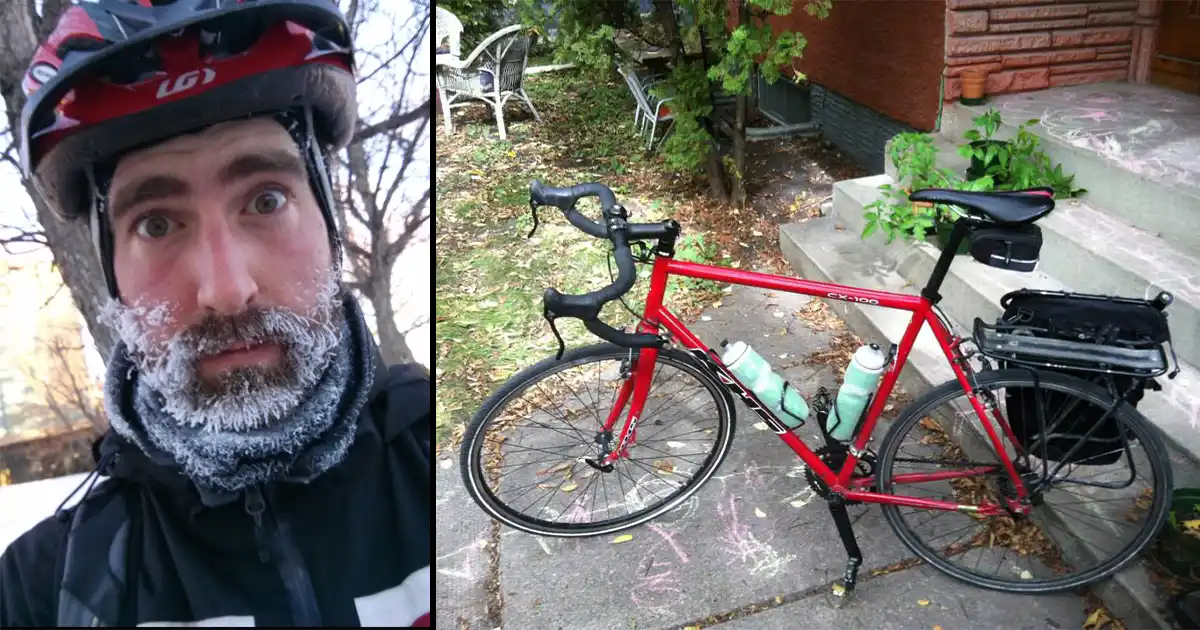
Then there was me with my heavy red KHS touring bike—the same steel tank I’d used to pedal across Canada the year before. No clip-in pedals. No carbon frame. Just a reliable workhorse that had gotten me thousands of kilometers but was absolutely not built for speed.
All I had going for me was the invincibility of youth and, honestly, no clue what I was getting myself into. But that’s what made it all the more exciting.
The Results
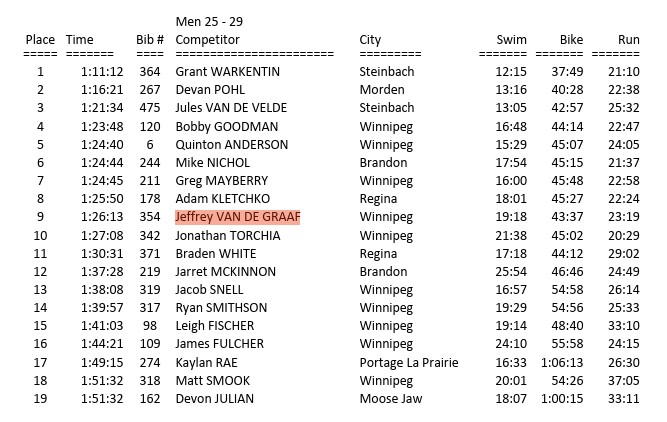
When the gun went off and I plunged into Clear Lake, those were the longest nineteen minutes and eighteen seconds of my life. There was one moment when I swam over a jungle of seaweed and I freaked out, but the adrenaline kicked in and I kept moving forward.
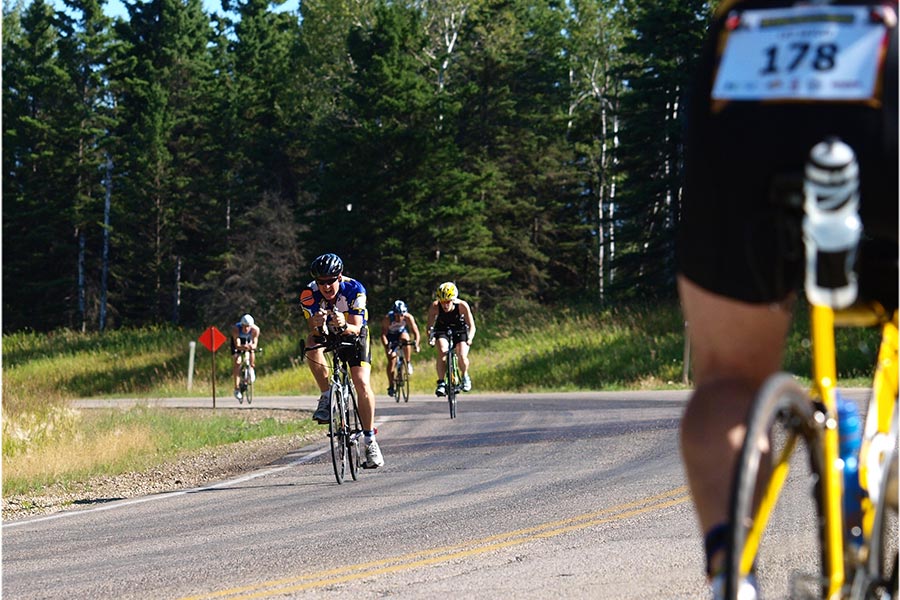
The bike leg was where I felt most in my element. Despite riding my heavy steel tank while carbon race bikes flew past me, I finished in 43:37—good enough for 4th place out of 19 in my age group (that felt damn good).
The run was fine. Not my strongest (or favorite) discipline, but I crossed the finish line in 23:19—averaging 4:39 per kilometer. Writing this now at 37 years old, I’m struggling to keep a sub-5:30 min/km pace. I was a much better runner in my mid-20s, and I didn’t do much training.
- Total time: 1:26:13
- 9th out of 19 in my age group (25-29)
- 52nd overall out of 110 competitors for the Sprint Triathlon
Conquering My First Triathlon
Overall, I’m happy with my results. Considering the minimal training and being traumatized by my dad when it comes to swimming in open bodies of water, I think I did alright.
Now, did I think there was a future in triathlons after this? Not really.
I already had my sights set on cycling across Asia the following summer. But standing at that finish line, exhausted and covered in sweat, I felt something I hadn’t felt in months: happy. Like I was myself again and for the first time since moving to Winnipeg, I was finally whole.
Hey—are you considering your first triathlon?
You don’t need expensive gear to compete in triathlons. All you really need is a swimsuit, goggles, a bike, and a pair of running shoes. I showed up with my steel touring bike. One competitor used a mountain bike from Walmart.
Triathlons aren’t just for elite athletes with carbon fiber everything and a helmet that looks like sperm (I’m sorry, but that’s just where my mind goes!).
They’re a way to challenge yourself, push your limits, and maybe—just maybe—find a piece of yourself you didn’t know was missing.
I’d recommend starting with a sprint. It’s the perfect distance to discover what you’re capable of.
And if you ever aspire to finish an Ironman one day, join my training journey at: